Charlie Dodgson
Well-known member
This thread attempts to answer questions about our irrigation system posed by @TorontoJoe . Several posts will follow.
Additional questions from anyone are welcome.
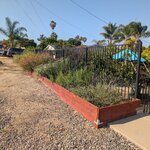
Our 1/4 acre property is in northwest Vista CA, just inside USDA zone 10b on the side of a ridge. Properties directly downhill from here are in zone 10a.
It does not freeze here. In addition, temperatures are rarely above the high 80°Fs, owing to the cool Pacific Ocean eight miles to the west. Unlike Atlantic coast waters that flow up from the Caribbean, our Pacific coast waters flow down from the Gulf of Alaska.
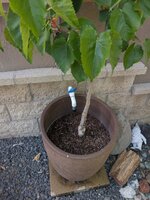
TorontoJoe's query was prompted by a photo similar to this one, of two outdoor plants on micro-irrigation. (The plants were previously rooted indoors.) The right-hand pot is a Stuewe TP49.
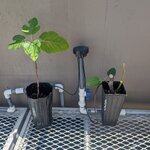
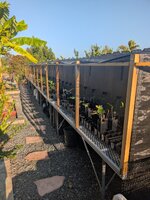
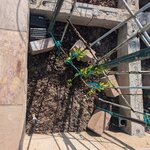
Along a portion of our southern fence, I have a row of five 8 ft. long x 2 ft. wide metal horticulture tables, piped with outdoor irrigation managed by hardwired indoor Rainbird SST controllers. There is a shade cloth canopy above the tables plus at the west and east ends. It not only provides shade, but also protects the plants from cloudbursts of heavy rain that occur here perhaps 6-8 times a year for 15 to 30 minutes.
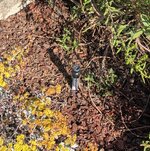
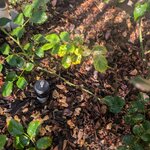
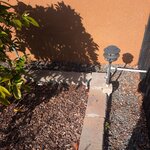
The irrigation supports risers, like the one in the photo above. On the risers are DIG 12-Outlet Manifolds. The manifolds come with tubing, filters, and emitters. These last two items are unsuitable for my purposes. I only use the tubing, allowing free-flow through the system, and attach it to Black High Flow 160° Spot Spitters (Primerus Products SS-AG160BLK-100). The controllers run this system on Thursdays and Sundays for 3 minutes (although manually disabled during wet weather or temperatures below 45).
There are only a few irrigated plants on the table in the photo, because it and one other are used one day per week for manual watering of my indoor orchid collection. The three other tables are packed with pot trays for extra rooted fig plants in MT38 pots.
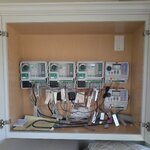
Next, the controllers.
Additional questions from anyone are welcome.
Our 1/4 acre property is in northwest Vista CA, just inside USDA zone 10b on the side of a ridge. Properties directly downhill from here are in zone 10a.
It does not freeze here. In addition, temperatures are rarely above the high 80°Fs, owing to the cool Pacific Ocean eight miles to the west. Unlike Atlantic coast waters that flow up from the Caribbean, our Pacific coast waters flow down from the Gulf of Alaska.
TorontoJoe's query was prompted by a photo similar to this one, of two outdoor plants on micro-irrigation. (The plants were previously rooted indoors.) The right-hand pot is a Stuewe TP49.
Along a portion of our southern fence, I have a row of five 8 ft. long x 2 ft. wide metal horticulture tables, piped with outdoor irrigation managed by hardwired indoor Rainbird SST controllers. There is a shade cloth canopy above the tables plus at the west and east ends. It not only provides shade, but also protects the plants from cloudbursts of heavy rain that occur here perhaps 6-8 times a year for 15 to 30 minutes.
The irrigation supports risers, like the one in the photo above. On the risers are DIG 12-Outlet Manifolds. The manifolds come with tubing, filters, and emitters. These last two items are unsuitable for my purposes. I only use the tubing, allowing free-flow through the system, and attach it to Black High Flow 160° Spot Spitters (Primerus Products SS-AG160BLK-100). The controllers run this system on Thursdays and Sundays for 3 minutes (although manually disabled during wet weather or temperatures below 45).
There are only a few irrigated plants on the table in the photo, because it and one other are used one day per week for manual watering of my indoor orchid collection. The three other tables are packed with pot trays for extra rooted fig plants in MT38 pots.
Next, the controllers.
Last edited:




 .
.