
You are using an out of date browser. It may not display this or other websites correctly.
You should upgrade or use an alternative browser.
You should upgrade or use an alternative browser.
Which varieties benefit the most from pollination?
- Thread starter DELFIG
- Start date


Bofig
Well-known member
All of mine ripened a lot earlier, like 2-6 weeks or more on some of the latest. I think all will benefit from pollination but I also think there is downsides because so many split easily with pollination, or even opened up like flowers an were magnets for bugsBesides the Smyrna varieties.....which common fig benefits the most from pollination?....
BOfig mentioned his Panache ripens early and tastes better......any others?

GoodFriendMike
Moderator
Most figs benefit from pollination. A couple years back I gave my wife two Celeste figs. One pollinated and one not. She could not believe they where the same fig. The pollinated one had some peach tones to it. Which she loved.

ktrain
Moderator
I think Smith was really good.
I also did WM#1...just to see how different it would be....it was better, but...
It was my first time hand pollinating and I had about a 60% success rate with it.
I did a few others but only noticed a slight difference.
I will do more in the future though.
I also did WM#1...just to see how different it would be....it was better, but...
It was my first time hand pollinating and I had about a 60% success rate with it.
I did a few others but only noticed a slight difference.
I will do more in the future though.
Bofig
Well-known member
I will second the yolo bypass, it was probably one of the top five out of hundreds this year with pollen, without pollen it would be like eating a mt Etna.Yolo bypass or feather river is spectacular pollinated. The best fig in my opinion. Unpollinated it isn’t special.
Panachee is night and day different with pollination. The fig becomes much denser and the flavor is both sweeter and sharper. VdB didn’t change as much, but still caprification adds the brightness to its molasses berry aspect. Black Madeira is way more berry with caprification too. The only variety that I think might be too strong after caprification is the CDDs. My CDDs is still young, so the sweetness seems to be muted by the acid from caprification. I’m hoping that it’s more balanced out with maturity.I pollinated Hardy Chicago, Panache, Marseilles, and VdB this year. All pollinated figs larger, a couple of weeks earlier. I don’t think it did much for Marseilles or VdB. Panache was ok (wasn’t a good year for it in general); Hardy Chicago was berrier than usual.
Last edited:
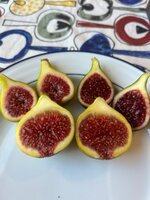
Panachee with and without pollination. Both are good. Pollinated it’s a top five fig for me. Top row are CDDs with and without pollination. Pollinated CDDs are almost too strong. Hopefully with more maturity, the sugar will be more prominentPanachee is night and day different with pollination. The fig becomes much denser and the flavor is both sweeter and sharper. VdB didn’t change as much, but still caprification adds the brightness to its molasses berry aspect. Black Madeira is way more berry with caprification too. The only variety that I think might be too strong after caprification is the CDDs. My CDDs is still young, so the sweetness seems to be muted by the acid from caprification. I’m hoping that it’s more balanced out with maturity.
Attachments


scott_va
Well-known member
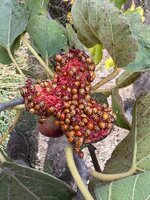
I wanted to pollinate Panache because in my environment on the East Coast, it’s not outstanding unpollinated. It’s also a splitter and if it wasn’t so pretty, it would have already hit the compost pile. All figs (pollinated and unpollinated) from it this year were very pineapple tasting. I will pollinate it again next year hoping for a better result. I’m wondering if it needs that West Coast dry heat to develop properly.
GoodFriendMike
Moderator
From the looks of it. You will never have an aphid problem.The varieties that typically split without pollination looked like this with pollination and minimal rain
View attachment 18447
Bofig
Well-known member
You know I’ve only ever had an aphid issue one time outside, I had an entire colony of ants protecting and farming them. One time I brought a handful in on a plant, sprayed it once and never saw another one. We don’t see much for aphids here but may people complain about them. The aphids tend to stay in the row crops rather than gardens when you live outside of townFrom the looks of it. You will never have an aphid problem.

I think Panachee split even more when caprified if there’s moisture.I wanted to pollinate Panache because in my environment on the East Coast, it’s not outstanding unpollinated. It’s also a splitter and if it wasn’t so pretty, it would have already hit the compost pile. All figs (pollinated and unpollinated) from it this year were very pineapple tasting. I will pollinate it again next year hoping for a better result. I’m wondering if it needs that West Coast dry heat to develop properly.
Bofig
Well-known member
Panache split just like my photo above when pollinatedI think Panachee split even more when caprified if there’s moisture.
I saw some later Panachee that split badly in our fall rain storms too.Panache split just like my photo above when pollinated

RosyPosy
Well-known member
The earlier ripening is not really a thing with pollination, you may get a couple of weeks max, but that is it. In studies, the difference was mostly in days. People have had pollinated figs for thousands of years, if there was a massive difference in ripening time, it would be well known, especially by commercial growers. If watching ripening times, be aware of which figs on the branch are being pollinated and their stage of growth in relation to others on the branch. It is not uncommon for fruit mid-branch to ripen first regardless of pollination. Also, hand pollinating may increase risk of spoilage which can make someone think figs are “ripening” sooner than they are. (Wasp pollination also can increase risk of spoilage for various reasons as well.)
Most figs will benefit from pollination. I think it’s almost easier to say which ones won’t benefit. Probably less difference will be noticed in Adriatic, Mt Etna, VdB types including RdB, and “Honey” figs. So far, I don’t like “honey” figs pollinated as much, because for me, they turn into more of a honey berry type fig and I end up having too many that taste that way. Also I think some of the “honey” varieties have more of a tendency to ferment with pollination. Smith, BM types, and DTE may not have as much difference either.
As oat said, Tiger Panache really benefits from pollination. Any in the Atreano family of figs, such as Thermalito, really benefit. I think Bourjassotte Grise may benefit as well. Emalyn’s Purple, UCR 187-25, 505-H or The Sisters, Brown Turkey types such as Lebanese Red, some Hivernenca types, Joualle Rouge and Noir all benefit… Some of it is subjective.
Most figs will benefit from pollination. I think it’s almost easier to say which ones won’t benefit. Probably less difference will be noticed in Adriatic, Mt Etna, VdB types including RdB, and “Honey” figs. So far, I don’t like “honey” figs pollinated as much, because for me, they turn into more of a honey berry type fig and I end up having too many that taste that way. Also I think some of the “honey” varieties have more of a tendency to ferment with pollination. Smith, BM types, and DTE may not have as much difference either.
As oat said, Tiger Panache really benefits from pollination. Any in the Atreano family of figs, such as Thermalito, really benefit. I think Bourjassotte Grise may benefit as well. Emalyn’s Purple, UCR 187-25, 505-H or The Sisters, Brown Turkey types such as Lebanese Red, some Hivernenca types, Joualle Rouge and Noir all benefit… Some of it is subjective.
Bofig
Well-known member
I will document it well this year, it was 2-6 weeks or more for me. Not just random ripening either, but a true earliness. I think many members that have hand pollinated will agree the earlier ripening is a true statement. Some did spoil but many did not, maybe only a handful I could attribute to the pollination alone.The earlier ripening is not really a thing with pollination, you may get a couple of weeks max, but that is it. In studies, the difference was mostly in days. People have had pollinated figs for thousands of years, if there was a massive difference in ripening time, it would be well known, especially by commercial growers. If watching ripening times, be aware of which figs on the branch are being pollinated and their stage of growth in relation to others on the branch. It is not uncommon for fruit mid-branch to ripen first regardless of pollination. Also, hand pollinating may increase risk of spoilage which can make someone think figs are “ripening” sooner than they are. (Wasp pollination also can increase risk of spoilage for various reasons as well.)
Most figs will benefit from pollination. I think it’s almost easier to say which ones won’t benefit. Probably less difference will be noticed in Adriatic, Mt Etna, VdB types including RdB, and “Honey” figs. So far, I don’t like “honey” figs pollinated as much, because for me, they turn into more of a honey berry type fig and I end up having too many that taste that way. Also I think some of the “honey” varieties have more of a tendency to ferment with pollination. Smith, BM types, and DTE may not have as much difference either.
As oat said, Tiger Panache really benefits from pollination. Any in the Atreano family of figs, such as Thermalito, really benefit. I think Bourjassotte Grise may benefit as well. Emalyn’s Purple, UCR 187-25, 505-H or The Sisters, Brown Turkey types such as Lebanese Red, some Hivernenca types, Joualle Rouge and Noir all benefit… Some of it is subjective.
My honey types did not stay a honey type once pollinated, many turned a blood red color and a strong berry flavor came out. The pulp was so red it stained fingers on a lot of them. I did post a difference in Izbat an naj with and without pollination showing color changes.
I would go as far as to say that all berry type figs are better with pollination. I don’t have any spoiled from the wasps. My orchard is really dry and moderate enough, that spoilage is not an issue. I would imagine that hand pollination introduces more pathogens especially if fluids are involved.The earlier ripening is not really a thing with pollination, you may get a couple of weeks max, but that is it. In studies, the difference was mostly in days. People have had pollinated figs for thousands of years, if there was a massive difference in ripening time, it would be well known. If watching ripening times, be aware of which figs on the branch are being pollinated and their stage of growth in relation to others on the branch. It is not uncommon for fruit mid-branch to ripen first regardless of pollination. Also, hand pollinating may increase risk of spoilage which can make someone think figs are “ripening” sooner than they are. (Wasp pollination also can increase risk of spoilage for various reasons as well.)
Most figs will benefit from pollination. I think it’s almost easier to say which ones won’t benefit. Probably less difference will be noticed in Adriatic, Mt Etna, VdB types including RdB, and “Honey” figs. So far, I don’t like “honey” figs pollinated as much, because for me, they turn into more of a honey berry type fig and I end up having too many that taste that way. Also I think some of the “honey” varieties have more of a tendency to ferment with pollination. Smith, BM types, and DTE may not have as much difference either.
As oat said, Tiger Panache really benefits from pollination. Any in the Atreano family of figs, such as Thermalito, really benefit. I think Bourjassotte Grise may benefit as well. Emalyn’s Purple, UCR 187-25, 505-H or The Sisters, Brown Turkey types such as Lebanese Red, some Hivernenca types, Joualle Rouge and Noir all benefit… Some of it is subjective.
I agree that the atreano family and Emalyn Purple become top-tier with pollination. BG is definitely much better pollinated too!