Water soluble fertilizer

danssale11

Well-known member
Hello guys.
Needed your opinion.

During the flowering phase of my plants for tomatoes, cucumber and peppers, I use Jack's 10-30-20. I just ran out and was looking for a less expensive option. I saw Schultz bloom booster(10-54-10). What are your thoughts of using this for Vegs and fruit trees(including fig). I was thinking of using it at half strength.

What are your thoughts on this? Has anyone used it for Veg/fruit? Any wisdom/pearls from experience?

Thank you

 
Hmmm. I don't think there's an option that's significantly less expensive. Are you buying the J.R. Peters Jack's Professional in the 25lb bags? The smaller formats are pricey. Get the big bags.

Another brand that's very similar is Grow-More

This is the large format Jack's collection

 
@danssale11

These are all good ferts but read the label. Many of the most common soluble offerings don't have a few micro's like calcium or iron. Just something to keep in mind depending on the situation. In ground not an issue but in a pot, it can be easy to get depleted on something like calcium.... which can mess up fruiting big-time
@RosyPosy has some posts on this
 
Bloom Boost type products are not necessary for figs and do not provide benefit. They are high in phosphorus, but it is a rip off because:

1) Plants only really uptake phosphorus through mycorrhizal fungi and phosphorus from organic matter. Plants do not really use this form of phosphorus, plus it is really toxic to waterways. So you’re paying for something your plant doesn’t even utilize, it becomes expensive and harmful runoff.

2) Figs do not use phosphorus at the “blooming” time when figlets are being formed. Phosphorus is used most at the very start of the season, likely for root growth. Growing roots is linked to shoot growth, and it is the shoot growth that leads to figs.

Your best bet for phosphorus is to apply it through something like bat guano or other bird manure, or compost. Apply it early in the season so that you get both the phosphorus and nitrogen at the time they are needed, and make sure microbes are being applied too. Teas made from these can be a good source of water soluble nutrients.

You can use bone meal as well, but it is very slow to become available. Turning it into a water soluble fertilizer with vinegar makes it immediately available. Fish hydrolysates also have a certain amount of phosphorus in them as well.

Calcium is more important than phosphorus, and I would be more concerned with that one. Soft rock phosphate is a great product and is actually higher in calcium than phosphate. If you can get that easily, I would use it.

Scrap the bloom boosters, they’re all marketing. 🙂
 
I went with osmocote plus this year and i will never go back to others. Its not nessecarily water soluable its controlled release and idk about comparing cost per doseage but it lasts 6 months and has just about anythinf your figs would want
 
Bloom Boost type products are not necessary for figs and do not provide benefit. They are high in phosphorus, but it is a rip off because:

1) Plants only really uptake phosphorus through mycorrhizal fungi and phosphorus from organic matter. Plants do not really use this form of phosphorus, plus it is really toxic to waterways. So you’re paying for something your plant doesn’t even utilize, it becomes expensive and harmful runoff.

2) Figs do not use phosphorus at the “blooming” time when figlets are being formed. Phosphorus is used most at the very start of the season, likely for root growth. Growing roots is linked to shoot growth, and it is the shoot growth that leads to figs.

Your best bet for phosphorus is to apply it through something like bat guano or other bird manure, or compost. Apply it early in the season so that you get both the phosphorus and nitrogen at the time they are needed, and make sure microbes are being applied too. Teas made from these can be a good source of water soluble nutrients.

You can use bone meal as well, but it is very slow to become available. Turning it into a water soluble fertilizer with vinegar makes it immediately available. Fish hydrolysates also have a certain amount of phosphorus in them as well.

Calcium is more important than phosphorus, and I would be more concerned with that one. Soft rock phosphate is a great product and is actually higher in calcium than phosphate. If you can get that easily, I would use it.

Scrap the bloom boosters, they’re all marketing. 🙂
Do you have a recipe for a bone meal-vinegar solution? And would I be right to assume that would have a lot of calcium, too, since it's made of bones?
 
Do you have a recipe for a bone meal-vinegar solution? And would I be right to assume that would have a lot of calcium, too, since it's made of bones?
Not to answer for rosy, but it’s usually 10-1 if I recall correctly(I don’t exactly measure) vinegar to calcium component. Yes it would contain quite a bit of calcium.
 
Do you have a recipe for a bone meal-vinegar solution? And would I be right to assume that would have a lot of calcium, too, since it's made of bones?
Yes, exactly. It would have all of the minerals that are in the bones. It is both calcium and phosphorus and more.

The recipe is 1 part mineral rich material to 10 parts apple cider vinegar. You can technically use other vinegars or even an equivalent citric acid solution, but I like using apple cider vinegar for my fruit trees as it has other benefits and isn’t made from anything GMO. I wrote an article about calcium vinegar extractions here, and the same process is used for any type of material, be it bone, shells, or plants. You do want the material broken into pieces, I don’t find powder ideal because it is hard to strain, but it does work. The larger the pieces the longer it takes to extract. Usually, it takes about 5-7 days and then you can strain it out and use the vinegar when you water or in foliar sprays.

The material is spent when it floats; the vinegar has extracted everything it can hold after it stops bubbling. When you give it a little swirl, check for bubbles coming off the material which tells you if the vinegar is still working on it. So if you don’t have floating material after the vinegar is done, you may be able to use it for subsequent extractions if desired.


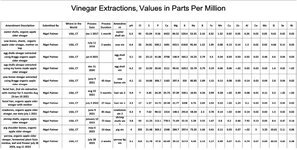
This is from Nigel Palmer’s website, he’s done analyses of various homemade amendments. This shows what can be in a bone extraction as well as others, you may need to click on it to enlarge it:

IMG_4144.jpeg
 
Yes, exactly. It would have all of the minerals that are in the bones. It is both calcium and phosphorus and more.

The recipe is 1 part mineral rich material to 10 parts apple cider vinegar. You can technically use other vinegars or even an equivalent citric acid solution, but I like using apple cider vinegar for my fruit trees as it has other benefits and isn’t made from anything GMO. I wrote an article about calcium vinegar extractions here, and the same process is used for any type of material, be it bone, shells, or plants. You do want the material broken into pieces, I don’t find powder ideal because it is hard to strain, but it does work. The larger the pieces the longer it takes to extract. Usually, it takes about 5-7 days and then you can strain it out and use the vinegar when you water or in foliar sprays.

The material is spent when it floats; the vinegar has extracted everything it can hold after it stops bubbling. When you give it a little swirl, check for bubbles coming off the material which tells you if the vinegar is still working on it. So if you don’t have floating material after the vinegar is done, you may be able to use it for subsequent extractions if desired.


This is from Nigel Palmer’s website, he’s done analyses of various homemade amendments. This shows what can be in a bone extraction as well as others, you may need to click on it to enlarge it:

View attachment 19818
Wow. Great info. Thanks. Can fish bonemeal be used as well to increase calcium supplement(vinegar+fish bonemeal)
 
Back
Top