Overwintering fig trees by bending to ground and covering

Woodlot

Well-known member
I'm growing in zone 8a. That makes fig growing a lot easier than many on this forum.

But still, every Spring, the leaf buds open beautifully, often forming full size leaves and good size breba fruit, then it happens!
The weather changes from highs near 90 and 60 degree nights, back to 45 degree highs and nighttime lows in the low to mid twenties. And it happens more than just one or two nights.

All the new growth dies. And that sets the tree back, what, almost 3 weeks?

Many growers rap standing trees with insulation to protect them from cold. But that seems less effective and way too much work as the trees get larger. I've already ruled that out.

So I have decided to follow the technique used by some in northern states where the trees are bent to the ground, covered with cardboard and protected by a heavy layer of wood chips.

It sure seems too late to bend erect 8 or 9 foot trees to the ground when the trunks are 3 inches in diameter. Right? Is the only way to cut these larger trees to the ground and bend down the new growth?

And what about erect trees with one+ inch diameter trunks? Does training these trees so they can be bent to the ground need to begin in Summer, and if so, what is the process? And do these trees ever break off while bending them down.

Any information would be greatly appreciated.

Perhaps there is a website or other source that describes the best ways to get trees shaped for this overwintering technique.

Thank you!
 
I'm growing in zone 8a. That makes fig growing a lot easier than many on this forum.

But still, every Spring, the leaf buds open beautifully, often forming full size leaves and good size breba fruit, then it happens!
The weather changes from highs near 90 and 60 degree nights, back to 45 degree highs and nighttime lows in the low to mid twenties. And it happens more than just one or two nights.

All the new growth dies. And that sets the tree back, what, almost 3 weeks?

Many growers rap standing trees with insulation to protect them from cold. But that seems less effective and way too much work as the trees get larger. I've already ruled that out.

So I have decided to follow the technique used by some in northern states where the trees are bent to the ground, covered with cardboard and protected by a heavy layer of wood chips.

It sure seems too late to bend erect 8 or 9 foot trees to the ground when the trunks are 3 inches in diameter. Right? Is the only way to cut these larger trees to the ground and bend down the new growth?

And what about erect trees with one+ inch diameter trunks? Does training these trees so they can be bent to the ground need to begin in Summer, and if so, what is the process? And do these trees ever break off while bending them down.

Any information would be greatly appreciated.

Perhaps there is a website or other source that describes the best ways to get trees shaped for this overwintering technique.

Thank you!
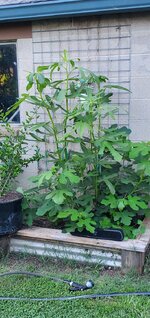
Great question I've wondered about
 
Don't prune nack the the newer growth from around the crown of the tree. Gradually bend it down over a few days or weeks. Weight it down with a big rock or something. Then cover with 4-6in of mulch or leaf litter. Cover it all with a tarp, so the mulch doesn't get soaked. I overwintered a Chicago Hardys and a Tena this way last winter here in 6b/7a.
 

Attachments

  • 20260602_193520.jpg
    20260602_193520.jpg
    231 KB · Views: 8
Don't prune nack the the newer growth from around the crown of the tree. Gradually bend it down over a few days or weeks. Weight it down with a big rock or something. Then cover with 4-6in of mulch or leaf litter. Cover it all with a tarp, so the mulch doesn't get soaked. I overwintered a Chicago Hardys and a Tena this way last winter here in
 
Wrapping the trees worked until we had a severe winter. Then I did the cover with mulch/leaves and then tarp with success until this last spring when we had the same 90* to 35* over and over. The excessive heat lasted too many days and started to rot the plants - but at least I only had one which lost a branch. This year will be cover with cardboard first, then mulch, then tarp. The cardboard creates an air barrier which helps prevent the molding/rot. The problem I had was waiting until last frost date passed. Fig anxiety!
 
Wrapping the trees worked until we had a severe winter. Then I did the cover with mulch/leaves and then tarp with success until this last spring when we had the same 90* to 35* over and over. The excessive heat lasted too many days and started to rot the plants - but at least I only had one which lost a branch. This year will be cover with cardboard first, then mulch, then tarp. The cardboard creates an air barrier which helps prevent the molding/rot. The problem I had was waiting until last frost date passed. Fig anxiety!
Were they hard to pull down to the ground? Any breakage?
 
I started out with protecting figs the classic way—in a loose garden soil, cut the lateral roots on 3 sides, tie the branches with string, wrap in burlap, and lay the tree down in a trench, hilling up the dirt on the sides. Place a piece of cardboard on top and cover with dirt. Use the rodent prevention of your choice.
 
Yes you literally have to train it down if your growth is fat, old & wont bend easily. It could take weeks! Starting in fall is not an option and rushing it will absolutely break branches youre trying to save.
Its easiest to train a new fresh branch to grow low from day 1. Otherwise it might take a considerable time to bend and even then the arch will be very high like a hump and kinda defeat the purpose.
 
Were they hard to pull down to the ground? Any breakage?
Not really. But then I didn’t have but 2-3 yr old branches due to them dying back to the ground before. I was worried about breakage but as in another comment, the biggest branches were gradually pulled over. Surprising how limber they are. I do have a patch I want to cordon grow.
 
I over wintered some trees in ground Japanese espalier style. They would be well protected from the cold but it is mice, voles, moles, chipmunks, and rats you have to worry about getting in there and chewing up your bark. Be sure to spray rodent repellent everywhere to keep them away. Wire mesh woven tight enough for them to not get in is a must.
 
I started out with protecting figs the classic way—in a loose garden soil, cut the lateral roots on 3 sides, tie the branches with string, wrap in burlap, and lay the tree down in a trench, hilling up the dirt on the sides. Place a piece of cardboard on top and cover with dirt. Use the rodent prevention of your choice.
I am thinking this is the tried and true method, proven for generations. But for a 70 yr old woman it just isn’t doable. I am still pretty strong but not nearly as much as before I almost died from Covid. If I only had 1-2 trees I would definitely go with this method, but with 22 already in ground and more in queue - that’s a lot of shoveling! Haha!
 
I over wintered some trees in ground Japanese espalier style. They would be well protected from the cold but it is mice, voles, moles, chipmunks, and rats you have to worry about getting in there and chewing up your bark. Be sure to spray rodent repellent everywhere to keep them away. Wire mesh woven tight enough for them to not get in is a must.
I have all those except haven't seen rats great info for me was wondering about my yard full of chipmunks moles/voles
 
I'm growing in zone 8a. That makes fig growing a lot easier than many on this forum.

But still, every Spring, the leaf buds open beautifully, often forming full size leaves and good size breba fruit, then it happens!
The weather changes from highs near 90 and 60 degree nights, back to 45 degree highs and nighttime lows in the low to mid twenties. And it happens more than just one or two nights.

All the new growth dies. And that sets the tree back, what, almost 3 weeks?

Many growers rap standing trees with insulation to protect them from cold. But that seems less effective and way too much work as the trees get larger. I've already ruled that out.

So I have decided to follow the technique used by some in northern states where the trees are bent to the ground, covered with cardboard and protected by a heavy layer of wood chips.

It sure seems too late to bend erect 8 or 9 foot trees to the ground when the trunks are 3 inches in diameter. Right? Is the only way to cut these larger trees to the ground and bend down the new growth?

And what about erect trees with one+ inch diameter trunks? Does training these trees so they can be bent to the ground need to begin in Summer, and if so, what is the process? And do these trees ever break off while bending them down.

Any information would be greatly appreciated.

Perhaps there is a website or other source that describes the best ways to get trees shaped for this overwintering technique.

Thank you!
On more thing - I know as the trees age it will not be so limber in the lower trunk and will have a higher arch. (The most arch my 3 yr old trees had last year was about 12”) I started looking at concrete curing tarps which are very insulated. Pricey for sure but may save a lot of trees.
 
I started out with protecting figs the classic way—in a loose garden soil, cut the lateral roots on 3 sides, tie the branches with string, wrap in burlap, and lay the tree down in a trench, hilling up the dirt on the sides. Place a piece of cardboard on top and cover with dirt. Use the rodent prevention of your choice.
That seems like a lot of root loss.
Did trees emerge from the severed roots in Spring?
 
Wondering your zone im new overwintering in 6b/a seen very good information want put one in ground close to house but more worried about the chipmunks I allow to free roam also mole/vole
 
Burying them works very well in the coldest of climates. It's an excellent method, but as @Italian4u mentioned you may need to protect from pests.

Interestingly, I started wrapping with added heat because I felt that burying them was way to much work. The wrap up is a bit tedious, but it's not back-breaking.... At least less so for me.

My $0.02
 
That seems like a lot of root loss.
Did trees emerge from the severed roots in Spring?
This was one tree with a stiff trunk in loose garden soil. It still had attached roots so it leafed out well in the spring. I certainly wouldn’t bury if I could bend.
 
Back
Top