My Results with In-Ground Fig Trees Over the Last Decade

Hello everyone,

It is a very important time to encourage in-ground planting among fig growers in cold growing zones. A lot of us (myself included) just experienced a catastrophic winter (and spring), as someone put it to me recently. This was the worst winter in the last decade at my location, similar to the previous decade's polar vortex in 2016. As a result, optimism is at an all-time low. Pretty sure that's when you buy, not double down.

For context, here are the temperatures at my location over the last decade (zone 7A):
  • 2026: -3 to 2F depending on the weather station you looked at. A total of about 5 nights around 5F. Total dieback of all varieties.
  • 2025: Three nights each reaching 4, 5, & 6F with a long duration. Extreme, but I still had good breba production. Some trees suffered total dieback.
  • 2023-24: Lows were in the high single digits to low teens. Mild.
  • 2022: 6F low. Short duration. Minor damage.
  • 2020-21: Lows were in the high single digits to low teens. Mild.
  • 2017-19: Temperatures reached the low single digits. Limited variety testing, but Hardy Chicago and Little Ruby were both exposed to 2F, suffering no winter damage.
Temperature Limits and Other Factors

Fig trees are pretty good above 5F. Below that, you're asking for trouble. I thought they could be more cold-tolerant than we give them credit for because of very credible reports claiming, "X fig variety was exposed to temperatures below 0F and didn't suffer any damage." This winter was exactly what I needed to disprove or prove my suspicions.

Duration is a huge factor. Maybe the claim that Campaniere can survive -4F is true if there was a short duration of exposure. I'm sure that's the case.

Lignification is overlooked. Far too often, I've read someone say, "X variety is or isn't hardy." Well... how can Hardy Chicago suffer from winter damage when only exposed to 20F? Also, just because you plant the hardiest fig variety in the world, it's not a guarantee your tree will become a large, established, and hardy fig tree. Plant it in another spot, and you may see significantly different results. That's been the case here with a handful of varieties.

Here's what else I found:

1. Your figs will taste significantly better when harvested from established in-ground fig trees than from their potted counterparts. You know how it's hard to go back to unpollinated figs once you eat your first pollinated fig? Well... in recent years, I barely ate the ones from the potted trees. I grow them in pots for trialing new varieties or pollination purposes. That's it.
2. Breba buds have nearly identical hardiness to the branches themselves.
3. The breba crop is severely underappreciated in colder growing zones.

I found that the breba crop is inconsistent when fig trees are grown in smaller pots (3-7ish gallons). Temperature fluctuations in the spring may cause trouble, but I find that you'll see much greater success with the breba crop if you're growing fig trees in larger pots. Or better yet, fig trees with a larger root system ripen the crop much more reliably. Regarding in-ground fig trees, I had also found that the breba crop doesn't delay the main crop's ripening date, the trees know what they can handle (and will reject the ones they can't), and the breba crop tastes nearly equal to the main crop on more varieties than you'd expect. Again, they also have a consistently higher fruit quality than the main crop produced from potted fig trees.

4. Unless you've got Carlos Rivera's microclimate or a greenhouse, potted fig trees ripen roughly at the same time as their in-ground counterparts. Even when comparing some late varieties like White Adriatic. Whether they're grown in pots or in the ground, I ripen White Adriatic's full crop here at roughly the same time.
5. You'll harvest way more figs. Having said that, you're not always going to have success. I'd be willing to bet you probably can with annual winter protection.
6. Protecting large fig trees can be easier than you think. Older wood is more pliable than most people imagine. Some folks wrap large fig trees. You could also drive a heavy-duty stake into the ground and ratchet-strap old trunks or scaffolds so they're positioned horizontally and closer to the ground, making them easier to cover.
7. Protecting a row of fig trees is easier than you think (see Hooiserbanana's or the late great Mario's method).

Now, that's a lot of claims I just made. You don't have to believe me, but a wise man once said, "You can lead a horse to water, but you can't make it drink." Herman2 said Mega Celeste was one of the worst figs for humid climates he'd ever grown on an old Figs4Fun thread. That was the gist of it anyway. What did I do? I grew Mega Celeste. Eventually, I realized the same thing.

I am guilty too. That's one example of the countless things experienced growers in the Northeast have told me that I didn't want to believe, but really, I wanted to find out for myself. If you want to do that, my hat's off to ya. Just know, there's a good chance that in 5-10 years, you might come to the same conclusions I have. You'll be kicking yourself, saying, "Why didn't I plant a fig tree in the ground sooner?" Or, "why didn't I give it the attention it deserved and protect the damn thing?"

You might be thinking, "Well, Ross, I have too many fig trees, how could I possibly protect them all?" What about protecting just one tree? I think that everything I said was leading to is... pretend we don't have access to 100s of varieties, choose one, plant it, and protect it every winter. You're going to be way better off most years.

Lastly, this year has really sucked so far. Most of us will have total dieback if we haven't recognized it already. Should we just give up? That's like saying, I should only grow Apricots in pots because, 1 in every 5 years, I lose the entire crop to late frost.

I successfully protected roughly 100 in-ground fig trees this winter. All those trees need is one more winter of protection or mild temperatures. They'll be back in business. And in a decade, after another crazy winter, this post will deserve a bump.
 
Last edited:
Interesting experience,

- I got a setup (DIY) for winter cold that really helped me with my potted figs in this year's cold. It's actually pretty nice helped me with temps reaching down 7-celcius. Straw was key here (see attachment)

Also potted figs need to be refreshed. I might make a video about it.
 

Attachments

  • file_00000000046c71f4b8439afd5b9abf4f.png
    file_00000000046c71f4b8439afd5b9abf4f.png
    2 MB · Views: 27
Hello everyone,

It is a very important time to encourage in-ground planting among fig growers in cold growing zones. A lot of us (myself included) just experienced a catastrophic winter (and spring), as someone put it to me recently. This was the worst winter in the last decade at my location, similar to the previous decade's polar vortex in 2016. As a result, optimism is at an all-time low. Pretty sure that's when you buy, not double down.

For context, here are the temperatures at my location over the last decade (zone 7A):
  • 2026: -3 to 2F depending on the weather station you looked at. A total of about 5 nights around 5F. Total dieback of all varieties.
  • 2025: Three nights each reaching 4, 5, & 6F with a long duration. Extreme, but I still had good breba production. Some trees suffered total dieback.
  • 2023-24: Lows were in the high single digits to low teens. Mild.
  • 2022: 6F low. Short duration. Minor damage.
  • 2020-21: Lows were in the high single digits to low teens. Mild.
  • 2017-19: Temperatures reached the low single digits. Limit variety testing, but Hardy Chicago and Little Ruby both survived 2F without damage.
Fig trees are pretty good above 5F. Below that, you're asking for trouble. I thought they could be more cold-tolerant than we give them credit for because of very credible reports claiming, "X fig variety was exposed to temperatures below 0F and didn't suffer any damage." This winter was exactly what I needed to disprove or prove my suspicions.

Duration is a huge factor. Maybe the claim that Campaniere can survive -4F is true if there was a short duration of exposure. I'm sure that's the case.

Lignification is overlooked. Far too often, I've read someone say, "X variety is or isn't hardy." Well... how can Hardy Chicago suffer from winter damage when only exposed to 20F? Also, just because you plant the hardiest fig variety in the world, it's not a guarantee your tree will become a large, established, and hardy fig tree. Plant it in another spot, and you may see significantly different results. That's been the case here with a handful of varieties.

Here's what else I found:

1. Your figs will taste significantly better when harvested from established in-ground fig trees than from their potted counterparts. You know how once you eat your first pollinated fig? It's hard to go back to unpollinated figs. Well... in recent years, I barely ate the ones from the potted trees. I grow them in pots for trialing new varieties or pollination purposes. That's it.
2. Breba buds have nearly identical hardiness to the branches themselves.
3. The breba crop is severely underappreciated in colder growing zones.

I found that the breba crop is inconsistent when fig trees are grown in smaller pots (3-7ish gallons). Temperature fluctuations in the spring may cause trouble, but I find that you'll see much greater success with the breba crop if you're growing fig trees in larger pots. Or better yet, fig trees with a larger root system ripen the crop much more reliably. Regarding in-ground fig trees, I had also found that the breba crop doesn't delay the main crop's ripening date, the trees know what they can handle (and will reject the ones they can't), and the breba crop tastes nearly equal to the main crop on more varieties than you'd expect. Again, they also have a consistently higher fruit quality than the main crop produced from potted fig trees.

4. Unless you've got Carlos Rivera's microclimate or a greenhouse, potted fig trees ripen roughly at the same time as their in-ground counterparts. Even when comparing some late varieties like White Adriatic. Whether they're grown in pots or in the ground, I ripen White Adriatic's full crop here at roughly the same time.
5. You'll harvest way more figs. Having said that, you're not always going to have success. I'd be willing to bet you probably can with annual winter protection.
6. Protecting large fig trees can be easier than you think. Older wood is more pliable than most people imagine. Some folks wrap large fig trees. You could also drive a heavy-duty stake into the ground and ratchet-strap old trunks or scaffolds so they're positioned horizontally and closer to the ground, making them easier to cover.
7. Protecting a row of fig trees is easier than you think (see Hooiserbanana's or the late great Mario's method).

Now, that's a lot of claims I just made. You don't have to believe me, but a wise man once said, "You can lead a horse to water, but you can't make it drink." Herman2 said Mega Celeste was one of the worst figs for humid climates he'd ever grown on an old Figs4Fun thread. That was the gist of it anyway. What did I do? I grew Mega Celeste. Eventually, I realized the same thing.

That's one example of the countless things experienced growers in the Northeast have told me that I didn't want to believe, but really, I wanted to find out for myself. If you want to do that, my hat's off to ya. Just know, there's a good chance that in 5-10 years, you might come to the same conclusions I have. You'll be kicking yourself, saying, "Why didn't I plant a fig tree in the ground sooner?" Or, "why didn't I give it the attention it deserved and protect the damn thing?"

You might be thinking, "Well, Ross, I have too many fig trees, how could I possibly protect them all?" What about protecting just one tree? I think that everything I said was leading to is... pretend we don't have access to 100s of varieties, choose one, plant it, and protect it every winter. You're going to be way better off most years.

Lastly, this year has really sucked so far. Most of us will have total dieback if we haven't recognized it already. Should we just give up? That's like saying, I should only grow Apricots in pots because, 1 in every 5 years, I lose the entire crop to late frost.

I successfully protected roughly 100 in-ground fig trees this winter. All those trees need is one more winter of protection or mild temperatures. They'll be back in business. And in a decade, after another crazy winter, this post will deserve a bump.
After watching an older video of yours on bending, securing, and covering with mulch for winter protection, I have done that for the last two years with 100% success. Before that I had wrapped extensively and still had die back to ground. This last year I also covered with a tarp and didn’t remove it soon enough and experienced some molding/rotting on one VdB branch. Since then I have seen your updated video about putting cardboard cover first and then the mulch. Changing my protocol for next winter. Thank you! BTW, I’m really liking the new website- so easy to navigate.
 
Our lowest was 5°F but it was during a week of nighttime lows in the sub 10°F. All unprotected trees in the neighborhood died to the ground except one HC which had about half above ground freeze damage (I think this tree was partially buried in 2-3 feet of piled snow during the worst weather). Figs protected by only a leaf mulch (no tarp or cardboard barrier) also froze to near ground level except for a fig with low lying limbs arranged in shallow ditches; those limbs were totally protected by only a leaf mulch.
 
Your takeaways are the opposite of my last decades experiences in z7 western NC. Thank you for sharing, though! My inground trees are all 2 months behind potted trees (even in my greenhouse) & 98% of my fruit is from potted trees. Soil temperature is the most obvious reason... My inground growing is mostly futile with exception of mt Etna types.

Again, very appreciative of all information so thank you!
 
Here in North Alabama we rarely get below 7*-14* f , the older folks who colonized our Valley here starting in the 30’s planted an odd fig tree here and there. One property from way back has the oldest I’ve found, an old Celeste or Celeste type tree.
But regardless of variety, they planted a single tree/variety and tended it. Now at least 50+ years later minimum, it is a huge multi trunk tree with trunks the size of my leg, and I’m not a small person.
This tree produces loads and loads of figs every year, and even in an off year it’s more than a few people will ever pic or eat, at least average people. Not everyone loves figs enough to eat 20 pounds worth over 1-2 months the way some of us do.

But point is, choosing a well proven variety that older growers or those with 10-20+ years experience depend on to have figs every year and establishing it in ground is a great Idea as stated above.
I have several chosen after 7 years testing that fruit each year here, and are in ground, or going in ground for me.
But one variety that is super vigorous and extremely fruitful right out the gate in ground for me is White Madeira #1. A good healthy Adriatic seems to love my climate as much or more than any other variety.
And even if it gets cut back to the ground each year , it’s more than able to grow many feet tall and be covered in figs that have time to ripen here. But I do live in a huge valley that can be just a few degrees warmer than all surrounding areas allot of the year so that gives me another leg up, then my protected microclimate within that valley also benefits my figs.
I’ve tested allot of varieties, and rarely does a variety grow so strong and want to fruit so heavily as WM#1. Year after year. So consider that if you live anywhere near my area.
 
Here in North Alabama we rarely get below 7*-14* f , the older folks who colonized our Valley here starting in the 30’s planted an odd fig tree here and there. One property from way back has the oldest I’ve found, an old Celeste or Celeste type tree.
But regardless of variety, they planted a single tree/variety and tended it. Now at least 50+ years later minimum, it is a huge multi trunk tree with trunks the size of my leg, and I’m not a small person.
This tree produces loads and loads of figs every year, and even in an off year it’s more than a few people will ever pic or eat, at least average people. Not everyone loves figs enough to eat 20 pounds worth over 1-2 months the way some of us do.

But point is, choosing a well proven variety that older growers or those with 10-20+ years experience depend on to have figs every year and establishing it in ground is a great Idea as stated above.
I have several chosen after 7 years testing that fruit each year here, and are in ground, or going in ground for me.
But one variety that is super vigorous and extremely fruitful right out the gate in ground for me is White Madeira #1. A good healthy Adriatic seems to love my climate as much or more than any other variety.
And even if it gets cut back to the ground each year , it’s more than able to grow many feet tall and be covered in figs that have time to ripen here. But I do live in a huge valley that can be just a few degrees warmer than all surrounding areas allot of the year so that gives me another leg up, then my protected microclimate within that valley also benefits my figs.
I’ve tested allot of varieties, and rarely does a variety grow so strong and want to fruit so heavily as WM#1. Year after year. So consider that if you live anywhere near my area.
Good information J man, WM#1 is one that has been in my collection probably since the beginning.
Every year it gets chopped up for cuttings, I think I'm going to start one that I don't prune so much...it has left this one a bit ugly with all the cuts. lol
 
For those who can’t handle multiple trees or even one in a pot. Best option would be is an in ground. I’m starting to suggest this to family because they can’t seem to handle one potted fig and honestly @TorontoJoe and my method would benefit everyone. No need to try different ways just 2 simple methods. Follow it and you’ll have success.
 
All great stuff.

Let's not forget even the same grow zones can be different. In my area, let's say 7a in the Lehigh Valley, Pa is a lot different than 7a West Philly with all of it's concrete, streets and buildings in close proximity of each other creating one big nice micro-climate. Something that I don't have, or I have to do my best to create a micro-climate myself.

And of course, as lots of others said, winter protection is a good idea in the NE.


For those who can’t handle multiple trees or even one in a pot. Best option would be is an in ground. I’m starting to suggest this to family because they can’t seem to handle one potted fig and honestly @TorontoJoe and my method would benefit everyone. No need to try different ways just 2 simple methods. Follow it and you’ll have success.

I know this 83 year old testa dura out my way. Try to tell the guy there's any way to over winter a fig tree other than laying it in a trench and burying it for the winter. He doesn't want to hear anyone's fancy new methods! :ROFLMAO:
 
I know this 83 year old testa dura out my way. Try to tell the guy there's any way to over winter a fig tree other than laying it in a trench and burying it for the winter. He doesn't want to hear anyone's fancy new methods! :ROFLMAO:
I know some Portuguese guys (brothers actually) that dig around the rootball, dig a trench then lay the whole fig tree down in the trench then bury it with dirt and leaves. They've been doing this every year for decades.

He'll also tell you to only bottle your wine when it's sunny outside, that way your wine is floral and crisp but smooth. He says if you bottle your wine when it's dark or rainey, cloudy the wine will be more tannic, acidic in other words wine with some bite to it. Now, you think he's joking, but he's not--it has to do with the atmospheric pressure.

Now I tell my guys about it because we bottle at night and what do they say? I get....

Ray Boy, you alright? You not on drugs are you?

Ray Boy, we don't care about sunshine, clouds or rain or that atmospheric s h i t, you know why? We bottle inside down in the basement.

Our wine has a lot of tannins and bite to it, sometimes so much we have to add fruit to smooth it out 🤣
 
Your takeaways are the opposite of my last decades experiences in z7 western NC. Thank you for sharing, though! My inground trees are all 2 months behind potted trees (even in my greenhouse) & 98% of my fruit is from potted trees. Soil temperature is the most obvious reason... My inground growing is mostly futile with exception of mt Etna types.

Again, very appreciative of all information so thank you!

I'm not saying this is your specific case, but I should qualify my position further to avoid confusion:

To fairly compare ripening dates of in-ground fig trees vs. growing them in pots, 75% of the length of a fig tree's 1-year-old wood must be preserved.

For example, greatly shortening the 1-year-old wood through pollarding, winter damage, or the inherent consequence of a low cordon system, fig trees may ripen their main crop 2 weeks later than fully preserving the 1-year-old wood. If a fig tree dies to the ground, the ripening date may be delayed by 2 months.

This is occurring because pruning or winter damage changes the hormonal balance within fig trees:

"Excessive heading cuts during dormancy severely disrupt hormonal equilibrium. By removing multiple auxin-producing tips, these cuts diminish apical dominance, causing a cytokinin-driven explosion of lateral buds and watershoots, which diverts nutrients from fruit set to vegetative growth.

Gibberellins amplify this by promoting elongated, non-lignified shoots that fail to harden before winter, reducing cold hardiness and preventing the tree from reaching its genetic potential.

Cytokinins further exacerbate the imbalance by delaying senescence in these shoots, prolonging energy drain, and inhibiting fruit bud initiation.

Overall, auxins' reduced presence fails to counteract this, leading to delayed or absent fruit set as the tree prioritizes recovery over reproduction."

I have written more about how hormones influence fig trees in this article for anyone interested: https://www.figboss.com/post/fig-tree-pruning
 
For those who can’t handle multiple trees or even one in a pot. Best option would be is an in ground. I’m starting to suggest this to family because they can’t seem to handle one potted fig and honestly @TorontoJoe and my method would benefit everyone. No need to try different ways just 2 simple methods. Follow it and you’ll have success.
Are these two methods linked anywhere?
 
Here in North Alabama we rarely get below 7*-14* f , the older folks who colonized our Valley here starting in the 30’s planted an odd fig tree here and there. One property from way back has the oldest I’ve found, an old Celeste or Celeste type tree.
But regardless of variety, they planted a single tree/variety and tended it. Now at least 50+ years later minimum, it is a huge multi trunk tree with trunks the size of my leg, and I’m not a small person.
This tree produces loads and loads of figs every year, and even in an off year it’s more than a few people will ever pic or eat, at least average people. Not everyone loves figs enough to eat 20 pounds worth over 1-2 months the way some of us do.

But point is, choosing a well proven variety that older growers or those with 10-20+ years experience depend on to have figs every year and establishing it in ground is a great Idea as stated above.
I have several chosen after 7 years testing that fruit each year here, and are in ground, or going in ground for me.
But one variety that is super vigorous and extremely fruitful right out the gate in ground for me is White Madeira #1. A good healthy Adriatic seems to love my climate as much or more than any other variety.
And even if it gets cut back to the ground each year , it’s more than able to grow many feet tall and be covered in figs that have time to ripen here. But I do live in a huge valley that can be just a few degrees warmer than all surrounding areas allot of the year so that gives me another leg up, then my protected microclimate within that valley also benefits my figs.
I’ve tested allot of varieties, and rarely does a variety grow so strong and want to fruit so heavily as WM#1. Year after year. So consider that if you live anywhere near my area.
I agree with your point about the Adriatic figs.

While Green Michurinska shows several clear differences from the classic White Adriatic fig, it does taste awfully similar.

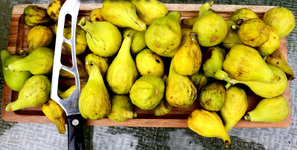
I think it's a better choice because its main crop ripens two weeks earlier (at the same time as Hardy Chicago here), and it produces a heavier breba crop. In 2024 and 25, it ripened many of them at nearly identical quality to the main crop. This is a photo of its breba crop from 2024.

1778370515313.png

I also had a lot of success River's pruning Green Michurinska in 2024. It produced 3 distinct crops of figs, ripening for 4 out of my 6 month frost-free growing season:

However, River's pruning does come with downsides, as the new growth that forms a second main crop does not lignify well enough in time for the winter.

 
Last edited:
@ross radd. Thanks for the post, and insight you shared. After winters like this past seasons it can really cause us to reflect on our strategies to prepare for them.
I know I found myself in a situation where the growing environment had changed around trees that I had planted almost 20 years ago. Becoming shaded more every year by fast growing evergreens. Winter damage coupled with Ambrosia beetles could be the end for a couple trees dear to me.
 
I agree with your point about the Adriatic figs.

While Green Michurinska shows several clear differences from the classic White Adriatic fig, it does taste awfully similar.

I think it's a better choice because its main crop ripens two weeks earlier (at the same time as Hardy Chicago here), and it produces a heavier breba crop. In 2024 and 25, it ripened many of them at nearly identical quality to the main crop. This is a photo of its breba crop from 2024.

View attachment 22592

I also had a lot of success River's pruning Green Michurinska in 2024. It produced 3 distinct crops of figs, ripening for 4 out of my 6 month frost-free growing season:

However, River's pruning does come with downsides, as the new growth that forms a second main crop does not lignify well enough in time for the winter.


Ross- thanks for post. Do you think pinching growth tips in June causes lignification problems in Fall/Winter?
 
'Cold growing zones' is a very broad term. In MY 6a/6b zone, I don't have enough of a season (GDD) to properly ripen very good figs, in pots or in the ground, without a headstart. To me, the whole point of growing figs in pots is to have the ability to reasonably easily headstart them. I see some growers trying to grow figs in the ground in my area, but the results have been very lackluster from what I've seen. On top, anything that ripens up here after mid-September can't come even close to figs ripened in July - beginning of September tastewise. An in ground fig tree may have 'way more figs', but what's the point of that if most/many of them won't ripen, and those that will, will not taste as good as those that will ripen in August on a potted tree.

'Growing in pots' is another generalization. A LOT of fig growers grow figs in 5-gallon pots. That is not the same as growing figs in 15-25 gallon pots. There is a huge difference in health, vigor, productivity and taste between a fig grown in a 5g pot vs a 15+ gallon pot.

It may very well be easier than one thinks to protect a large tree or a row of trees, but first and foremost, it has to make sense to do so. Not all 'cold growing zones' are created equal.

I had a chance to taste well-ripened caprified figs from established trees. A limited experience, but I did not find them 'significantly better' than my top potted figs. In some cases I preferred the taste of my figs.
 
This past winter at one property a White Madeira # 1 was placed in ground and grown to a single whip then bent down and covered. At the second location 4 trees were placed in ground and grown via Japanese espalier style. Each tree from left to right was 4 feet across. They were Campaniere, Moro da Caneva, Green Michurinska, and Ondata. They all made it through the winter. We had temps in the Chicagoland area zone 6A formerly 5B that hit -11F to -15F and with windchill the feels like temps were at -30F. It was cold. So in my zone I was hit with a hail storm and 3 frosts. Beginning of all we gad temps in the 80’s F and so trees that were potted were taken out April 14th. Not to long after that we got hit with a hail storm and then temps dipped into the 30’s F at night. The results were 3 light frosts but frosts non the less. Trees are alive but sadly set back for the year. I will upload video to YT later on their current condition. They will bounce back. Ironically my Black Madeira UCD was unscaved by the hail and multiple frosts. I’m still scratching my head on how that happened but I’ll take it.
 
Back
Top