Done with rooting cuttings

I see folks referring to DE. I assume they means Diatomaceous Earth. Is there a coarse DE I don’t know about? Or is this a reference to the safety sorb material? Which is caclined clay ( or Fullers Earth) which is not DE.
 
Generally I find that most of my very cheap and commonly available cuttings pull through just fine. It's the extremely expensive, haute couture cuttings that seem to like croaking on me! 😡
Hehe yeah thaths often the case here also i mean i am very happy with the 30% that did make it honestly since there is a green michurinska that made it and the cuttings came straight from penandpike😄

Also my last batch i did without adding ferteliser and used coco coir 60% and 40% perlite so ill see how that turns out if they make it the succes rate goes up to 50% atleast😁
 
Rooting is very easy… the problem comes in when it’s made complicated. And there is too much bad advice. A lot of people say you must do this and you must do that— when those things are not true. For example— Water never kills cuttings, it is the mix becoming waterlogged and compacted to where there is no oxygen. It is lack of air that kills cuttings. If water killed cuttings, people would not be able to water root.

There is only one solution to that which is to add air pockets with something like perlite. If you have to measure water to make sure it’s not too much, you know it’s wrong.

Compost isn’t good for indoor rooting mostly because it does attract fungus gnats, it can hold too much moisture, and sometimes it’s not fully broken down. It can work outside though with sufficient perlite added.

There must be other gardening things like sand, decomposed granite…? Coco coir is a very good rooting medium. Factually speaking, it does hold less water than peat. The problem it can have is salinity.

But honestly, your problem in this case was the rooting hormone. The pictures you showed have the classic symptoms. Rooting hormone burns out cuttings and does cause rot. I would bet your success rate would dramatically improve just by dropping that alone.

You may want to try rooting outside. Some people do a lot better with it because it completely eliminates heat mats and fungus gnats.
I love some of the things @Inflorescence said in this thread. People often omit the size of the perlite to be used. Perlite number one and two are basically useless. They can even retain water in a mix. LOL perlite # 4 is just too big. I recommend #3 it's the perfect size. Heat Matts thermostats malfunction all the time. Recommend you use a timer if you need supplemental bottom Heat. 20 or 30 minutes on and off with the timer will solve most of that. Don't over wrap your cuttings. If you're going to tape a cutting don't go below a half inch to an inch Max. @Inflorescence used to recommend using a semi-gloss to full gloss latex indoor paint to seal the very top of a cutting. I still think this may be the best method of all. Scoring, or scraping a cutting is not useful, and can induce Rot underneath the lignified bark, and the cambium layer of the cutting. That type of rot happens very fast, and is nearly always fatal. The reason a lot of people score or scrape is that in many plants this will induce non-differentiated cell matter which will then form adventitious roots under the soil line. I've never seen non-differentiated cell matter form this way in a fig cutting. So no sense doing it.
 
I initially thought I liked rooting with DE, but it seemed to suck the moisture away from the roots. And when trying to up pot the DE would adhere to and break the roots. Contrary to common belief, fungus gnats will set up shop in DE as well.
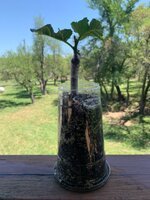
I now keep it pretty simple. I wrap in buddy tape, use an organic mix plus perlite, root outside, and have good success. A friend of mine who used to run a commercial pecan orchard and has rooted 1000s of trees over the years told me about his own rooting method…which is not earth shattering, but works for him. He inverts a plastic cup so that water disperses at the bottom and the cutting is less likely to rot. His method makes up potting simple because the cup lid is easily removed and the tree slides right out. As a bonus, the cups are less likely to fall over in the wind or if a clumsy person or pet bumps them. 🤗
 

Attachments

  • IMG_5190.jpeg
    IMG_5190.jpeg
    309.4 KB · Views: 9
I initially thought I liked rooting with DE, but it seemed to suck the moisture away from the roots. And when trying to up pot the DE would adhere to and break the roots. Contrary to common belief, fungus gnats will set up shop in DE as well.
I now keep it pretty simple. I wrap in buddy tape, use an organic mix plus perlite, root outside, and have good success. A friend of mine who used to run a commercial pecan orchard and has rooted 1000s of trees over the years told me about his own rooting method…which is not earth shattering, but works for him. He inverts a plastic cup so that water disperses at the bottom and the cutting is less likely to rot. His method makes up potting simple because the cup lid is easily removed and the tree slides right out. As a bonus, the cups are less likely to fall over in the wind or if a clumsy person or pet bumps them. 🤗

Apparantly, when rooting in DE, the rule about holding back on water is reversed. One needs to water heavily and keep the DE fully hydrated all the time. This is only anecdotal... I've never successfully rooted in DE. I tried it once with the incorrect medium.
 
For hundreds of years pure coarse sand was the rooting media of choice. It doesn’t get any more simple than that. Drains well, doesn’t water log, and produces lots of fibrous roots. It’s just heavy.
 
I have not seen undifferentiated cell matter forming where the wounds are on any cutting. That is the reason most people scrape cuttings. With figs I have not seen undifferentiated cell matter form nor adventitious roots coming out of non-differentiated cell matter. So no reason to scrape and there is a big risk.
 
I have used a few different methods with varying success. I really liked this year’s for simplicity. 50/50 peat to coarse perlite. Peat rehydrated in boiling water. Squeeze dry. Only an inch of the top of the cutting exposed and that waxed. Deep pots (I used half gallon milk cartons) with the bottom of the cutting 2 inches above the bottom of the pot. No scoring, rooting compound or clonex. Recut the bottom of the cutting 1/4 inch below a node. Weigh and mark weight. No heating pad, place on a high shelf in a heated house in the dark for 3 weeks covered loosely by a plastic shopping bag. Then into a cardboard box with artificial lighting. Weigh twice a week and adjust moisture per weight (you are more likely to overwater).
Of course the cuttings I just stuffed in a pot full of potting soil and left in the garage all winter are leafing out and seem to be putting out roots now.
 
I see alot of responses stating a 5/1 ratio. Medium to water. I go by feel, and Im probably more in the 7/1 range, I think 5/1 is the absolute wettest you want to be. Its important to point out that the 5/1 only holds true if your medium is dry to start with. Many bags are torn or open and get wet or absorb alot of atmospheric mositure which will throw your volume measured ratio off a good bit.
I do the same 1:7 to 1:8 by volume. My Promix is kept indoors bag open to ensure it is bone-dry when I mix it.
 
Been there - done that.

It's odd because this year I started late in rooting my cuttings (2 weeks ago) and they've been in my crisper drawer for over 3 months prior and so far they are all making it past the rotting point.

Last year I started them a week after acquiring them and had many losses (about 35-45%) and after reading a few post above I think the medium NEEDS to be wrung out as much as possible - I didn't (wring) with this seasons cuttings but maybe the sticks where dryer than freshly cut sticks and that's the reason last year I had so many rot on me.
 
Definitely agree.

The more fig cuttings we have rooted the more we see in figs is that wounding is ultimately detrimental.

This is very interesting. Scoring the cuttings is one of those things that is regurgitated pretty much everywhere. I do it. I do get heavy root development around the scored area. You’re saying it cause more problems than benefits?
 
This is very interesting. Scoring the cuttings is one of those things that is regurgitated pretty much everywhere. I do it. I do get heavy root development around the scored area. You’re saying it cause more problems than benefits?
We find that an open wound can introduce rot.
It does depend on how you score it. If you run a knife blade vertically on the stem only putting in slice but not to remove any bark that can produce roots, but if you do like most other plants and cut it scrape away bark that on wound is more detrimental than helpful. In our experience.
 
We find that an open wound can introduce rot.
It does depend on how you score it. If you run a knife blade vertically on the stem only putting in slice but not to remove any bark that can produce roots, but if you do like most other plants and cut it scrape away bark that on wound is more detrimental than helpful. In our experience.

Typically I scrape lightly, just removing the brown and exposing some green.
 
Back
Top