Comparisons of LSU DC-2, DC-6, and DC-7 ripened main crops

Charlie Dodgson

Well-known member
For those growing all three, perhaps you could post pictures and dates of ripened main crop figs; both external before cutting open and internal sliced longways so the eye is sliced in half. Please indicate whether the syconium was caprified by injection, by wasps, or not at all.
Thank you in advance. I hope to have a few to add later this year.
 
Here's some main crop characteristics of the "DC" figs I've assimilated to date:

 
  • Like
Reactions: cdh
Here's some main crop characteristics of the "DC" figs I've assimilated to date:


Are any of the DC figs related to the named, common LSU cultivars?
 
Good to know! Thanks. Follow-up question. Are the caprifigs used in the O'Rourke breeding program known/still extant?
C-1 is still around. L55-13-39 some believe is the same as C-1. If that is the case, Then it is still around.
If it is something different. It very well may be lost.
 
  • Like
Reactions: cdh
Are the caprifigs used in the O'Rourke breeding program known/still extant?
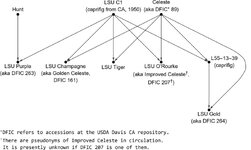
Below is a breeding diagram of figs released by the LSU program.

Cutting(s) of the C1 caprifig were sent to O'Rourke in 1950. The UC Fig breeding program had been under the direction of Ira Condit at the UC Agricultural Research Station in Riverside CA, with much of the science and breeding taking place in Porterville CA, 215 vehicle miles north of UCR. In 1950, the adminstration of the UC breeding program was transferred to UCR and Ira Condit retired to work on his monograph and other matters. At this point in time, the fig breeding program was two generations past Calimyrna. Enderud would not be selected until 1958. Thus, C1 was a closed-eye predecessor to Enderud, Saleeb, etc.

In 1998, offspring of C1 and Celeste were transferred to the LSU Hammond Research Station. In the following decade, Ed O'Rourke stated in an interview that C1 had been lost when the orchard it was contained in was bulldozed for a new dormatory on the main LSU campus. However, some collectors claim to have found a map and located C1 at Hammond circa 2015. However, that map was of the LSU campus orchard. In 2018, the director of the Hammond Research Station told me that the existence of C1 was a myth.


LSU breeding diagram.jpg
 
Below is a breeding diagram of figs released by the LSU program.

Cutting(s) of the C1 caprifig were sent to O'Rourke in 1950. The UC Fig breeding program had been under the direction of Ira Condit at the UC Agricultural Research Station in Riverside CA, with much of the science and breeding taking place in Porterville CA, 215 vehicle miles north of UCR. In 1950, the adminstration of the UC breeding program was transferred to UCR and Ira Condit retired to work on his monograph and other matters. At this point in time, the fig breeding program was two generations past Calimyrna. Enderud would not be selected until 1958. Thus, C1 was a closed-eye predecessor to Enderud, Saleeb, etc.

In 1998, offspring of C1 and Celeste were transferred to the LSU Hammond Research Station. In the following decade, Ed O'Rourke stated in an interview that C1 had been lost when the orchard it was contained in was bulldozed for a new dormatory on the main LSU campus. However, some collectors claim to have found a map and located C1 at Hammond circa 2015. However, that map was of the LSU campus orchard. In 2018, the director of the Hammond Research Station told me that the existence of C1 was a myth.


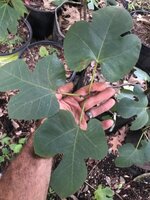
View attachment 23641
C-1 is grown to this day at the Hammond research station. The leaves are different than any other historical persistent Capri I have trialed.
Still would love to find Hamma and the Kac Capri. But at this point. I feel I will not. Creating better may be the next step. :)
 
So much about the LSU breeding program we will never know. And so much is still argued.
Would love to know all of the true history.
See page 9.
Leaves are similar to Tiger. But Tiger is not a Capri.
LSU Hammond has a caprifig marked as C-1. If it is L55-13-39.
Then that makes me happy. Maybe the imposter C-1 we talked about is the real one?
Much about the breeding program seems to be lost. Sad.
 
@GoodFriendMike
I empathize with your belief that you have C1. However, above you stated

Now in article p486 above, Both O'Rourke and Johnson provide a diagram showing that L55-13-39 was bred from Celeste and C1.
Well, If I am incorrect and have L55-13-39 offspring of C-1 and Celeste. Also thought lost. Then that is even better. Is it not?
Great candidate for breeding here in the south. :)
 
Back
Top