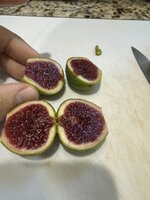
Clarification on "Adriatics"

Ikibahd

Well-known member
I have found that I have several varieties in my collection that could be lumped in the "Adriatic" type, but I am hoping to get a bit more clarification on what constitutes an Adriatic vs what one might call "Adriatic-adjacent" figs...

From what I gather, most people consider Adriatic varieties to be ones that are green skinned but with blood red interior and with intense berry / strawberry / raspberry and very sweet tasting pulp.
Some varieties that I learned about as being fantastic Adriatic type figs have a more yellow-green skin once ripe but are also deep red inside. Some call these Adriatic types still, but others say that are really not... where should that distinction truly lie?

Are "true" Adriatic types Always green on the outside even when fully ripe? Or do they change color slightly based on location, sun exposure, nutrients, etc.?

What makes Green Michurinska different enough that many say "it's not really an Adriatic type?" Is it the earliness whereas most known Adriatics are very late? Is it the leaf shape? Is it the flavor? Many with shorter seasons more or less feel that it tastes indistinguishable, but maybe that is only in a short season that more nuanced flavors cannot come forward?

Another variety that sticks out in my memory is grosse monstrueuse de lipari. I first read about it as an amazing Adriatic variety, but over time growers stated how it is not an Adriatic after all, just a good fig in its own right. It has green skin and blood red insides for some, but ripens more yellow for others.

I understand that a lot of this might be explained by some of the same varieties being sold (hyped) as new varieties with exciting new names, or old varieties found as unknowns that eventually "became" new varieties. Further, perhaps the fig wasp has to do with other nuances of color and flavor?

I just enjoy knowing as much as I can about the varieties that I grow (it's part of my passion / obsession with the hobby) but it becomes difficult to pin down what belongs in what "category" especially when I will eventually need to pare down my collection for space...

I hope this sparks some stimulating discussion, pictures of fruit and leaves, etc. - I love learning from others' experience!
 
I’ve given up on the Adriatic grouping after reading that Dalmatie (a green-skinned, red-pulped fig with a berry flavor that originated on an island off the Croatian coast in the Adriatic Sea) is not considered an Adriatic fig. I’m not arguing with anyone, the classification just doesn’t work for me.
 
Definitely a difficult classification category.

An example of a fig that matches the green and red description and the geography is one that is under discussion in another thread: @figologist 's Margarita, which is reportedly from the Greek island of Corfu--which is in the Adriatic Sea--and looks and tastes like an Adriatic fig by all reports.

1778861134500.png

Green Michurinska, being from Bulgaria, is at least arguably not geographically Adriatic, though it matches the general physical description.

1778861171060.png

And Smith, which some people consider Adriatic, is reportedly from Croatia (therefore geographically "Adriatic") but doesn't *quite* have the physical characteristics:

1778861487991.png


"Adriatic" is still useful though, in my opinion. It imparts information, albeit imperfectly. Similar to "Mt. Etna."
 
Are "true" Adriatic types
The term "Adriatic" was coined in California by G.N. Milco in the 1800's for a small orchard of trees growing on a property of a client. Milco took cuttings and distributed (sold) them nationwide. This cultivar is distributed by the USDA as DFIC 32. A few years later, W.B. West of California traveled to the Mediterranean to obtain fig cuttings on behalf of G.P. Rixford and F. Roeding. Among them was a different Italian variety he distributed as "White Adriatic". The latter is believed to be "Verdone".

It's worth noting that at the time, there were no fig cultivars circulating in the eastern hemisphere under the name "Adriatic". Instead, "Verdone" was widely known as "Verdoni" and "Fico di Fragola" -- the latter referring to its strong strawberry flavor.

Now fast forward 100 years to the 1980's. The name "Adriatic" was still not used in the eastern hemisphere in a reference to a fig cultivar, but collectors in the USA had begun using it to refer to figs with a strawberry flavor. In particular, sellers began using the label to group strawberry tasting figs. The latter practice continues today.

Overall, one can observe that a "true" Adriatic fig category never existed, in past or present. It would be of great benefit to collectors and the general public if the term were dropped and replaced with "Strawberry".
 
The term "Adriatic" was coined in California by G.N. Milco in the 1800's for a small orchard of trees growing on a property of a client. Milco took cuttings and distributed (sold) them nationwide. This cultivar is distributed by the USDA as DFIC 32. A few years later, W.B. West of California traveled to the Mediterranean to obtain fig cuttings on behalf of G.P. Rixford and F. Roeding. Among them was a different Italian variety he distributed as "White Adriatic". The latter is believed to be "Verdone".

It's worth noting that at the time, there were no fig cultivars circulating in the eastern hemisphere under the name "Adriatic". Instead, "Verdone" was widely known as "Verdoni" and "Fico di Fragola" -- the latter referring to its strong strawberry flavor.

Now fast forward 100 years to the 1980's. The name "Adriatic" was still not used in the eastern hemisphere in a reference to a fig cultivar, but collectors in the USA had begun using it to refer to figs with a strawberry flavor. In particular, sellers began using the label to group strawberry tasting figs. The latter practice continues today.

Overall, one can observe that a "true" Adriatic fig category never existed, in past or present. It would be of great benefit to collectors and the general public if the term were dropped and replaced with "Strawberry".

Is Verdoni a misspeling of Verdino? Italian names can frustratingly easily change meanings if you switch vowels around. For example, if Verdino is a misspelling of Verdoni, it changes the literal meaning from Verdoni's "Big Green Ones" [plural] to Verdino's "Little Green One" [singular]. Similarly, the vernacular meaning changes from Verdoni meaning "dark green [ones]" to Verdino meaning "pale green [one]."
 
I have read people say in forums things like this when talking about varieties like Green Michurinska, "That's not an Adriatic because it ripens much earlier than Adriatics". This is said by people that have a certain list of the "real Adriatics". In their mind, if it's not on their list, it's not an Adriatic. Does this mean there are no early Adriatics?
 
Why does it matter?
I suppose it mostly matters to me to help narrow down what varieties to let go of versus what to keep.

The more in depth reasoning behind that is that so many of my trees are very different ages and I have collected too many. In order to best evaluate them all, I feel that they need at least 3 seasons of growing, and some of mine are still merely sticks that I’m waiting on roots popping.

If, say, green Michurinska is likely the best tree for me in this environment, maybe I should ditch Unk. Prosciutto, Strawberry Verte, St. Martin, Angelito, etc.
But if these have true differences, then I might eventually keep 1 of each that are less similar to each other…

I am not about to go tossing my plants out but that was my thought process behind the post: get a better understanding of what constitutes this particular “kind” of fig in order to better categorize and better focus my collection in advance of time.
 
I suppose it mostly matters to me to help narrow down what varieties to let go of versus what to keep.

The more in depth reasoning behind that is that so many of my trees are very different ages and I have collected too many. In order to best evaluate them all, I feel that they need at least 3 seasons of growing, and some of mine are still merely sticks that I’m waiting on roots popping.

If, say, green Michurinska is likely the best tree for me in this environment, maybe I should ditch Unk. Prosciutto, Strawberry Verte, St. Martin, Angelito, etc.
But if these have true differences, then I might eventually keep 1 of each that are less similar to each other…

I am not about to go tossing my plants out but that was my thought process behind the post: get a better understanding of what constitutes this particular “kind” of fig in order to better categorize and better focus my collection in advance of time.
I would never ditch Angelito or Unk Prosciutto. I don't know if Saint Martin is an Adriatic
 
Back
Top