

You are using an out of date browser. It may not display this or other websites correctly.
You should upgrade or use an alternative browser.
You should upgrade or use an alternative browser.
Bug?
- Thread starter Motherwise
- Start date


EtchedFicus
Well-known member
I think that is a fungus like saprobes and not insect eggs
Motherwise
Well-known member
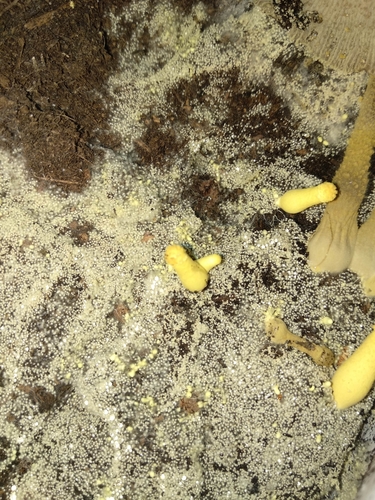
I did look up mycelium and sclerotia of Leucocoprinus birnbaumii and it can occur in the soil as well as on top. It does appear to be this. The ‘web like’ is the mycelium and what I thought were eggs would be the sclerotia. Question now - does is need to be treated? Will it harm the fig plant?I think that is a fungus like saprobes and not insect eggs
Motherwise
Well-known member
Found this info. Waiting on the experts at iNaturalist to confirm.
 inaturalist.nz
A review of the literature on sclerotia in Leucocoprinus species and other Agaricales · iNaturalist NZ
Abstract Whilst there are many fungi known to produce sclerotia, documentation of them in *Leucocoprinus* species is lacking with only a few species recorded as producing them and little information on each. As *L. birnbaumii* is one of the most common species to find in plant pots and has...
inaturalist.nz
Motherwise
Well-known member
This was a new brick of coco coir. I use 50/50 with perlite for cuttings. Different seller. It must have come in that. I’m just glad it wasn’t spider eggs….!Shouldn’t be harmful. Fungi is beneficial to trees and plants. If it was added to your soil mix (mycorrhizae inoculant), it looks like maybe a chunk didn’t mix in well and that cup got it all.

RosyPosy
Well-known member
Well, seeing that much in one cup would make me uncomfortable, so I understand your concern with it. It is odd for that to happen. I believe you also had one cutting with mold, is this the same one or is it the same mix? Or do I have the wrong person in mind?This was a new brick of coco coir. I use 50/50 with perlite for cuttings. Different seller. It must have come in that. I’m just glad it wasn’t spider eggs….!

Motherwise
Well-known member
That was me with the mold issue. Caused by the parafilm too close (and even under) the soil line. Rectified that on all the cuttings. A few others had begun to mold as well. Fortunately (and grateful for this group) it was caught early. Everything looks healthy. Good lesson for me to learn.Well, seeing that much in one cup would make me uncomfortable, so I understand your concern with it. It is odd for that to happen. I believe you also had one cutting with mold, is this the same one or is it the same mix? Or do I have the wrong person in mind?
Only 4 were with the new brick of coco coir, and upon closer inspection I have seen a tiny bit of fungus in the other 3 as well. So I’m thinking it had to come from the new coco coir.
RosyPosy
Well-known member
That was me with the mold issue. Caused by the parafilm too close (and even under) the soil line. Rectified that on all the cuttings. A few others had begun to mold as well. Fortunately (and grateful for this group) it was caught early. Everything looks healthy. Good lesson for me to learn.
Only 4 were with the new brick of coco coir, and upon closer inspection I have seen a tiny bit of fungus in the other 3 as well. So I’m thinking it had to come from the new coco coir.
Hmm… Yeah, it sounds like this coco coir may have been contaminated. If they don’t say they added mycorrhizae to it on the package, which I would be surprised if they did with a brick, then it probably is something else local to whoever sold it to you.
There is good fungus and bad fungus. It’s hard to say with this one, but I wouldn’t use this product again if it’s only happening with it.
You could try adding in a lactic acid bacterial product to help tame it down.

NYC_Fignetic
Well-known member
i would repot that, wash out the roots.
RosyPosy
Well-known member
So I did some research on it because I was curious as I have not seen that before.
1) It seems quite common to coco coir bricks. It came up A LOT in cannabis growing forums. However, it can happen in any potting mix medium. It is also a common issue for reptile enclosures/ terrariums.
2) Some refer to it as hyphal knots (aka spores) others as saprophytic fungi. It can develop when moisture is high and there is lack of air flow.
3) It seems to be “flower pot fungus” spores. If allowed to remain, they form into yellow mushrooms (not edible). It can run its course over a few weeks and then disapear.
The general consensus is to cut back on moisture and to physically remove the spores with a spoon or stick if you can without hurting the plant. Some say just sticking something in there and moving it gently around to break them up and mix them back in is sufficient.
They are considered relatively harmless to plants and an indication of a healthy, bioactive soil environment, though they can cause concern whenever people see them because they can be unsightly to some. The main concern is if the potting mix is remaining too wet for an extended period. They come because of decaying organic matter in the potting mix. They feed on it and break it down into nutrients for plants.
But it is totally normal, they typically disappear, and you don’t have to do anything if you don’t want to, outside of making sure moisture and air flow are okay.
1) It seems quite common to coco coir bricks. It came up A LOT in cannabis growing forums. However, it can happen in any potting mix medium. It is also a common issue for reptile enclosures/ terrariums.
2) Some refer to it as hyphal knots (aka spores) others as saprophytic fungi. It can develop when moisture is high and there is lack of air flow.
3) It seems to be “flower pot fungus” spores. If allowed to remain, they form into yellow mushrooms (not edible). It can run its course over a few weeks and then disapear.
The general consensus is to cut back on moisture and to physically remove the spores with a spoon or stick if you can without hurting the plant. Some say just sticking something in there and moving it gently around to break them up and mix them back in is sufficient.
They are considered relatively harmless to plants and an indication of a healthy, bioactive soil environment, though they can cause concern whenever people see them because they can be unsightly to some. The main concern is if the potting mix is remaining too wet for an extended period. They come because of decaying organic matter in the potting mix. They feed on it and break it down into nutrients for plants.
But it is totally normal, they typically disappear, and you don’t have to do anything if you don’t want to, outside of making sure moisture and air flow are okay.
Last edited:

TorontoJoe
Administrator
While I'm a fan of living soils... Having experienced a couple of indoor infestations. I now sterilize any growing medium that's going to be used inside my house. I know this will kill off many of the beneficials as well but for me the pro's have well outweighed the con's. In theory a good quality potting mix (or coir/perlite) will be free of eggs and pests, but in the environments where they're blended and stored there are many opportunities for contamination.
For me, baking significantly reduces the risk of anything undesirable (and also desirable) surviving in there...
Almost 2 weeks has passed. How's it looking now?
For me, baking significantly reduces the risk of anything undesirable (and also desirable) surviving in there...
Almost 2 weeks has passed. How's it looking now?
Last edited:
Motherwise
Well-known member
They seem to be doing well.While I'm a fan of living soils... Having experienced a couple of indoor infestations. I now sterilize any growing medium that's going to be used inside my house. I know this will kill off many of the beneficials as well but for me the pro's have well outweighed the con's. In theory a good quality potting mix (or coir/perlite) will be free of eggs and pests, but in the environments where they're blended and stored there are many opportunities for contamination.
For me, baking the significantly reduces the risk of anything undesirable (and also desirable) surviving in there...
Almost 2 weeks has passed. How's it looking now?
Attachments


TorontoJoe
Administrator
Motherwise
Well-known member
Update:
One Leucocoprinus birnbaumii which came in a brick of coco noir popped out of the soil. A few others are trying to reach the surface. Although these have been slower than the others to put out big roots, they are still quite vigorous in growth.
One Leucocoprinus birnbaumii which came in a brick of coco noir popped out of the soil. A few others are trying to reach the surface. Although these have been slower than the others to put out big roots, they are still quite vigorous in growth.
Attachments


TorontoJoe
Administrator
Not bug, some sort of mycellium. No big deal. Probably these yellow guys called flower pot mushrooms. Only thing is make sure the soil isnt too wet.
View attachment 19259
Pretty cool bright yellow!