I've been watching videos by Gary Matsuoka and a few others about mineral-based soils (Grows Gone Wild and The Graft Man are two others). Gary's theory is that organic matter in containers decomposes, depletes oxygen, and leads to anaerobic decomposition. The roots are then starved of oxygen and get root rot from the anaerobic conditions. This doesn't affect things like tomatoes or figs as much as other plants, like English lavender, that need a lot of oxygen around their roots. English lavender apparently needs the most root-level oxygen and is the most susceptible to root rot of any plant Gary has studied. And it's well known as a plant that can die from "overwatering"/letting the root zone stay wet.
So I have devised a study--not really a bona fide scientific experiment--to see if my results match what Gary and the others would predict.
I got a small English lavender plant from a nursery. I rinsed off all the wood and compost it was planted in from around the root ball. I then replanted it in a mix of sand, leca balls (clay), and a little bit of peat. Peat, while organic, breaks down much more slowly than wood does, and so this soil mix would be considered mineral-based.
I'm going to try to keep the lavender pot almost completely waterlogged with tap water. Since tap water is aerated, this should allow enough oxygen to get to the roots.
If Gary's theory is correct (and if I don't kill the plant some other way), the lavender should thrive despite being almost continuously "over watered." And the directions on the lavender plant tag to let the plant fully dry between waterings should be rendered moot (at least with my chosen soil composition). I'll try to post results every now and then for anyone who cares to follow along.
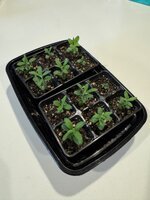
Here is the English lavender plant on Day 2, about 20 hours after transplant (with a 4x9 tree pot for comparison):
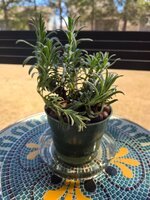
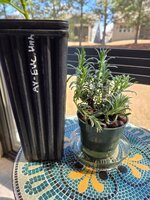
Note that the clear plastic tray is filled to the brim with water.
I'll put it in full sun in a day or two.
A potential confounder: I put some Osmocote in the pot. It could theoretically break down more quickly immersed in water than is intended, which could burn the roots or make the water too saline.
So I have devised a study--not really a bona fide scientific experiment--to see if my results match what Gary and the others would predict.
I got a small English lavender plant from a nursery. I rinsed off all the wood and compost it was planted in from around the root ball. I then replanted it in a mix of sand, leca balls (clay), and a little bit of peat. Peat, while organic, breaks down much more slowly than wood does, and so this soil mix would be considered mineral-based.
I'm going to try to keep the lavender pot almost completely waterlogged with tap water. Since tap water is aerated, this should allow enough oxygen to get to the roots.
If Gary's theory is correct (and if I don't kill the plant some other way), the lavender should thrive despite being almost continuously "over watered." And the directions on the lavender plant tag to let the plant fully dry between waterings should be rendered moot (at least with my chosen soil composition). I'll try to post results every now and then for anyone who cares to follow along.
Here is the English lavender plant on Day 2, about 20 hours after transplant (with a 4x9 tree pot for comparison):
Note that the clear plastic tray is filled to the brim with water.
I'll put it in full sun in a day or two.
A potential confounder: I put some Osmocote in the pot. It could theoretically break down more quickly immersed in water than is intended, which could burn the roots or make the water too saline.