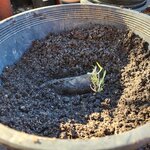
Interesting plant for replacing fertilizer @ Sterile Comfrey

I saw an ad for Giant Shinsu Runner Beans @ the largest bean @ a burrito in every pod lol...they are 12-19% protein and so they would make a great survival food ...

The store happened to have Bocking #14 root sections for $6... 1 Crown for $15


Unfortunately they are sold out of giant beans
 
Mike Piersimoni posted the below on his fb fig group.
“Comfrey one of the best natural fertilizers you can grow, and you should start now.
Comfrey is a pretty, compact plant that grows about 3 ft tall and 3 ft wide. It has large green leaves and pink to purple flowers. A vigorous grower but there is something you have to know before purchasing a comfrey root for growing. Comfrey is an invasive plant, it can take over an entire area if the seeds are spread. That's why it's important that you find a variety that seeds are sterile. I know of two Russian varieties called Bocking 4 and Bocking 14. They don't come in seeds they come in Roots or crowns. The crowns tend to grow faster but the roots will grow very well also.
They grow very fast, so starting one now in a pot you can be harvesting your first crop in early summer. And then subsequent crops every 6 to 8 weeks. The first year I grew started from a root in a pot in March I was able to get 3 harvests. The amazing thing about comfrey besides medicinal purposes, (look them up) are that the tap roots eventually can go down to 20 to 30 ft. They pull up all minerals from deep in the Earth and put them in their leaves. The leaves can can be chopped put in a bucket filled with water and in about 6 to 8 weeks the whole thing breaks down and becomes a liquid fertilizer. You can add the leaves to your compost pile or you can just chop and drop the leaves around your plants and eventually they will break down and feed the soil. Another thing you have to know about confrey it is the smelliest of all the natural fertilizers. Worse than plain fish emulsion.
So it's basically meant for outdoor growing. With chop and drop you don't get the smell and the smell from the liquid does dissipate in a couple of days once you feed your plants and trees. But until then the way I can describe the smell is raw sewage. Not pleasant but the plants and trees love it. Besides having NPK (1.80-0.50-7.30 )it has a ton of natural nutrients and minerals pulled up from deep in the ground where most trees and plants would never be able to get them. Once the liquid is ready there's usually a dilution factor of about water to liquid 5 to 1 to 10 to 1. So a 5 gallon bucket can go a long way. And you can also use a higher value dilution if you like. I bought three roots on Amazon for around $15. The next season I was able to harvest roots from them and plant them. I now have 10 plants lined up at a fence line and can now Harvest at least four times a season. You can strain the liquid and also spray your plants but that would be the smelliest way. Highly recommended and free.”

I have done the chop and drop and used it as liquid fertilizer. Its definitely a cheaper alternative.
I live in WNC also. I have Bocking 14 comfrey. Easy to grow but don't make a tea. Worst smell ever. I cut 3 or 4 times a year and put in compost or around fruit trees.akes an attractive plant also.Sorry to get in this thread late but just joined last week.
 
Mike Piersimoni posted the below on his fb fig group.
“Comfrey one of the best natural fertilizers you can grow, and you should start now.
Comfrey is a pretty, compact plant that grows about 3 ft tall and 3 ft wide. It has large green leaves and pink to purple flowers. A vigorous grower but there is something you have to know before purchasing a comfrey root for growing. Comfrey is an invasive plant, it can take over an entire area if the seeds are spread. That's why it's important that you find a variety that seeds are sterile. I know of two Russian varieties called Bocking 4 and Bocking 14. They don't come in seeds they come in Roots or crowns. The crowns tend to grow faster but the roots will grow very well also.
They grow very fast, so starting one now in a pot you can be harvesting your first crop in early summer. And then subsequent crops every 6 to 8 weeks. The first year I grew started from a root in a pot in March I was able to get 3 harvests. The amazing thing about comfrey besides medicinal purposes, (look them up) are that the tap roots eventually can go down to 20 to 30 ft. They pull up all minerals from deep in the Earth and put them in their leaves. The leaves can can be chopped put in a bucket filled with water and in about 6 to 8 weeks the whole thing breaks down and becomes a liquid fertilizer. You can add the leaves to your compost pile or you can just chop and drop the leaves around your plants and eventually they will break down and feed the soil. Another thing you have to know about confrey it is the smelliest of all the natural fertilizers. Worse than plain fish emulsion.
So it's basically meant for outdoor growing. With chop and drop you don't get the smell and the smell from the liquid does dissipate in a couple of days once you feed your plants and trees. But until then the way I can describe the smell is raw sewage. Not pleasant but the plants and trees love it. Besides having NPK (1.80-0.50-7.30 )it has a ton of natural nutrients and minerals pulled up from deep in the ground where most trees and plants would never be able to get them. Once the liquid is ready there's usually a dilution factor of about water to liquid 5 to 1 to 10 to 1. So a 5 gallon bucket can go a long way. And you can also use a higher value dilution if you like. I bought three roots on Amazon for around $15. The next season I was able to harvest roots from them and plant them. I now have 10 plants lined up at a fence line and can now Harvest at least four times a season. You can strain the liquid and also spray your plants but that would be the smelliest way. Highly recommended and free.”

I have done the chop and drop and used it as liquid fertilizer. Its definitely a cheaper alternative.

I just ordered a root fragment of Bocking 14... and then i learned more about why #4 is different... #14 is said to go up to 6 feet deep... #4 is described as having larger leaves but with a taproot down as deep as 10 feet...and so probably why it is said to be more heat tolerant... it brings nutrients up from even deeper than #14

I was concerned about spreading but in reading ive seen people say it gets to around 3 or 4 feet wide in 10 years not sure which type but so long as it is a sterile variety, it does not seem too extreme ... #4 which is also said to have a higher protein content is probably best for this location since we have very hot summers...

I found a video I wanted to post which is basically JDAM but i havent located a postsble link that isnt facebook. You fill a huge bin or barrell with leaves and use a weight to press it, and one hole at the bottom for the juice to roll out, and it dissolves into a rich black liquid fertilizer that people say smells really bad...then mix 1 to 10 with water and Bam
I came across the site below after ordering the bocking#14. They offer #4 for around $1 per root section and so ill probably try it also ... I can grow clumps and drop it around fruit trees and also feed the worms with it to make the vermicompost even richer

Here is the source for #4 i found
(i have yet to order from this site)
Russian Comfrey Live Root Cuttings - Bocking 4 – Yumheart Gardens

***Oops. I looked at their stored and recognized their Sunchoke photo. Ive been collecting the ones that are called dwarfs and crumpets. Turns out I have purchased from Yumheart but theough a third party site rather than their Shop store ***
 
Last edited:
Another plant to look up for fertilizer would be the Mexican Sunflower (Tithonia diversifolia and Tithonia rotundifolia) . It is a nutrient-rich plant used as green manure. I started growing it last year and have cuttings overwintering, but I have yet to use it as a fertilizer.
 
Great thread! I am going to trial a chop and drop planting in two of my orchard triads this growing season after looking into this. Each triad is 3 fruit trees on 9' centers. Each tree will get 3 comfrey plants, each triad gets 2 lemongrass plants, which are chopped and layered on top of the cut comfrey leaves. Additionally, the middles of each triad will be seeded to Dutch white clover and have a few strawberries crowns planted. Other suggested additions are yarrow and lemon verbena for each triad.

I hope to be able to grow enough propagative material in year 1 to plant the rest of my triads in year 2. Approximately 15 triads in total.

My concerns are not providing snake habitat, but I love the idea of the guild and having a fertilizer factory onsite. I'm also hoping for a cooling effect beneath the trees to mitigate the intense summer heat.
 
Someone shared an idea with me for growing Comfrey. I have a shaded strip that is in between the driveway and house. Im not sure if it gets sun all year but possibly at the peak of summer ... I was going to line with some small maples at one point... now im thinking I can space them inbetween sort of like shrubs... and at another spot as an understory near the compost area since its too shady for most fruiting plants ... also near easements where not to plant things you do want to have dig up unexpectedly

Also I ended up getting #4 Crowns from Yumheart but they have a better shipping price on Etsy or Ebay vs their website... a really easy price for several but I went with crowns since I havent decided how many I want to experiment with... and a cutting of #14 maybe in the mail by tomorrow ...

ill start these off in pots and think it through
 
Back
Top